

How long the border crossing takes from Uzhhorod and Mukachevo
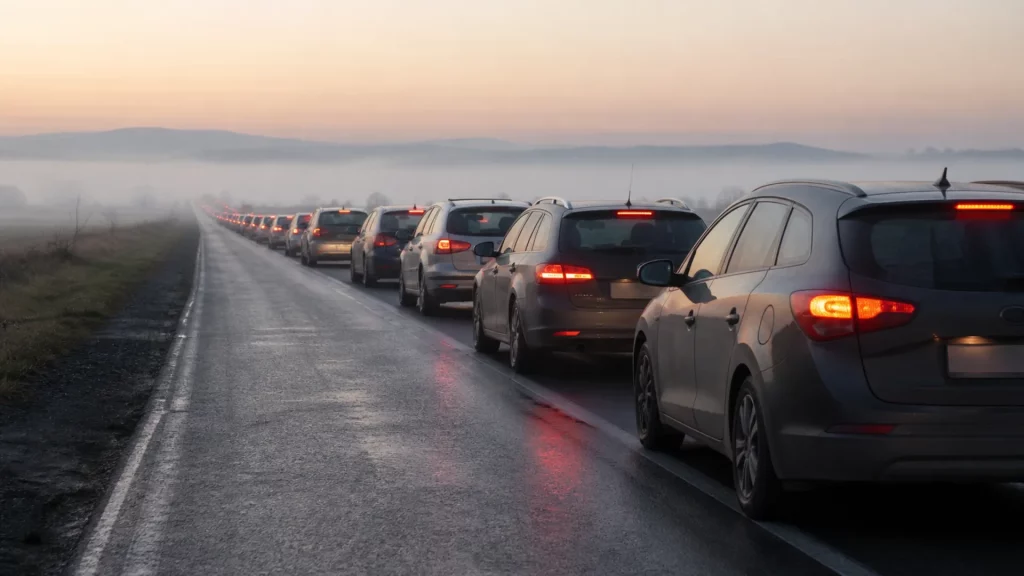
This question comes up more often than any other, and it is usually phrased simply: how long will we stand at the border? The honest answer is short. Nobody can name an exact figure, and anyone who does is making it up. That does not mean planning is impossible. Waiting time depends on a handful of understandable factors, and most of them can be weighed up before you pick a date.
What follows is a practical breakdown: which crossing points are nearby, what genuinely affects the wait, how an organised group differs from a private car, and how to build your day around it.
Why Zakarpattia works so well for day trips
Geography is on the traveller’s side here. Uzhhorod and Mukachevo sit close to the western border, and several crossing points are only tens of kilometres away. That is precisely why one-day trips abroad from Zakarpattia are a workable format rather than an endurance test: you do not lose the first day travelling to the starting point.
The practical consequence is that routes run for roughly 14 to 20 hours, from the shortest trips to the twenty-hour run to Salina Turda in Romania. The full list with the duration of each destination is on the excursions to Europe page.
Which crossing points are nearby
Zakarpattia borders several countries, and road crossing points are spread along the region. The best known directions look like this:
- towards Slovakia - Uzhhorod (Vysne Nemecke) and Malyi Bereznyi (Ubla);
- towards Hungary - Chop with the exit to Zahony, Luzhanka (Beregsurany) and Vylok (Tiszabecs);
- towards Romania - Diakove (Halmeu) and Solotvyno (Sighetu Marmatiei); worth noting that Solotvyno is a Ukrainian village in Zakarpattia rather than a Romanian one, although the name often causes confusion.
There is no direct road from Zakarpattia into Poland or Austria: routes to Poland and Austria pass through neighbouring countries. The list of crossing points and their opening hours change from time to time, so it is worth checking the current situation separately before a trip; the carrier selects the route for a specific date with the current conditions in mind.
What actually determines the waiting time
There are not many variables, but none of them are under your control and none follow a formula.
- How busy a specific crossing point is at a specific hour. This is the main factor and it shifts throughout the day.
- The work of the services on both sides. You pass the border twice, on exit and on entry, and these are two independent procedures, each with its own pace.
- Day of the week and season. Weekends, public holidays and peak tourist periods are traditionally busier than the middle of a working week.
- The profile of the traffic. Cars, lorries and coaches move differently, and the balance between them at a given crossing affects the pace too.
- One-off circumstances such as roadworks, changes to opening hours, weather or enhanced checks. These cannot be predicted in principle.
Any figure in a programme is therefore a guide rather than a guarantee. We word it that way deliberately: the return time is approximate, and the total duration of a route already includes the border with a margin.
Why a group crosses the border differently from a private car
The difference here is organisational rather than a matter of privilege, and it deserves an honest description.
First, a coach is a single vehicle with a single set of documents for the whole group, rather than twenty separate cars in a queue. The group leader prepares the lists in advance and handles the paperwork, so the time goes on the procedure itself rather than on working out who is missing what.
Second, at a number of crossing points traffic for coaches is organised differently from car traffic. That does not mean a coach skips the queue: nobody guarantees that, and the queue itself does not disappear.
Third, and this matters most in practice, in a group the border is not your problem. You are not deciding which crossing to use, watching the navigation or calculating whether the fuel will last. An experienced driver and group leader do this daily.
Fourth, a group crosses together. If one person has a question about their documents, everyone waits, which is why checking passports in advance is in your own interest.
Documents: where trips most often fall apart
Experience shows that trips fail because of documents rather than queues. The rule is a biometric international passport valid at least three months beyond your return date. An internal passport or ID card is not sufficient for crossing the border, and a child travels on their own international passport.
Now an important caveat, and it is a matter of principle: border crossing rules are set by legislation and they change. We give no advice here on visas, entry regimes or exit conditions, and we strongly advise against relying on someone else’s experience from a forum. Check the current requirements for your specific situation in official sources before you travel, and raise organisational questions with our manager when booking.
How to plan the day so the border does not ruin the evening
A few rules remove most of the disappointment.
- Plan nothing unmovable for the evening of your trip. No meetings, no train, no connecting flight. This is the single most important rule.
- Judge the route duration soberly. Fourteen hours and twenty hours are different propositions; if you have work the next morning, take a shorter destination.
- Bring water and a snack. A queue is the one stretch of road with no shop nearby.
- Arrive at the meeting point 10 to 15 minutes before departure. The manager will tell you the exact time when confirming your booking, because it depends on the date and the route.
- Arrange a pick-up in advance. Departure is from Uzhhorod; joining in Mukachevo or other towns of Zakarpattia is possible by prior arrangement only, and it must be agreed at the booking stage.
- Charge your phone and bring a power bank. A small thing, but on a long day it saves you.
What this means for choosing a destination
The border is a constant part of any one-day trip abroad from Zakarpattia, and it is the same for all five destinations. The difference between routes is not about where the queue is shorter but about the overall length of the day: the shortest trips to Hungary and Slovakia take less time than the longer routes to Romania, such as the twenty-hour trip to Salina Turda, or the shopping run to the Parndorf outlet.
If you are travelling for the first time, the simpler logic is this: take a shorter route, see how it feels at your own pace, and only then plan a long day. You can compare durations, prices and programmes for every destination on the one-day excursions to Europe page, where all five countries are gathered together.
One final thought that takes away most of the tension. The border is not an obstacle to the trip; it is part of it, already built into the calculation. It only becomes irritating when you were not counting on it.