

Mammoth Trees in the Carpathians
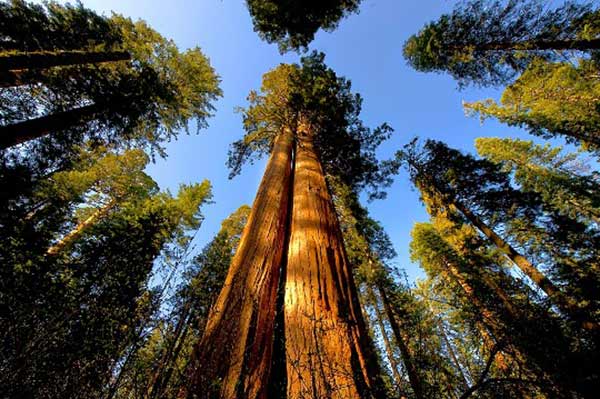
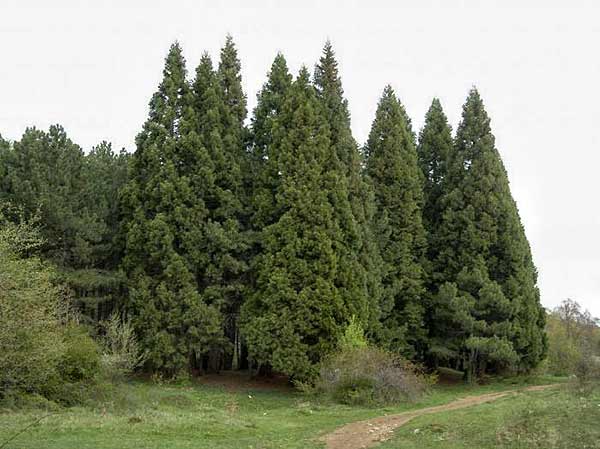 We have already grown used to the fact that the Carpathians - are mostly slender spruces and beeches. Admittedly, you won’t surprise anyone here with oak, lime or birch either… However, it may come as quite a surprise to many that in the Carpathian forests one can come across real mammoth trees, or sequoias. Yes indeed, these are those very tallest trees on planet Earth, which compete in size with skyscrapers!
There live four Transcarpathian sequoias on the territory of the Velykyi Bychkiv forestry and hunting enterprise, namely in the Luzhany forestry, in the Malyi Banskyi tract at an altitude of 520 m above sea level.
But how did these “giant newcomers”, whose homeland is the distant Pacific coast of North America, come to appear in our region? One might say - by the will of fate!
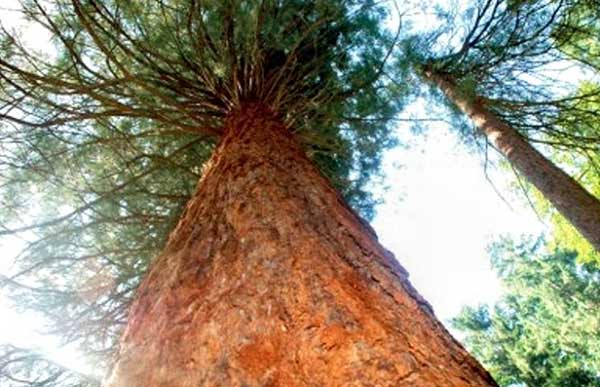 The mammoth trees settled here almost a century ago. Back in 1920, a temporary nursery was set up on a clear-cut, where the seeds of various tree species were sown. Sequoias among them. By chance or not, the seeds sprouted, and from that sowing these four giant trees. True, by the parameters accepted for the sequoia species, the Transcarpathian specimens are actually complete babies. At present their height is a mere 45 - 55 m, and that is less than half the height reached by the world record-holders of their species. And an age of 94 years (very venerable for a human) is, by the measure of these trees - quite early childhood. For a better understanding of the scale, this comparison is apt: just as the life of some little insect is almost imperceptible to us, so is human life fleeting for a sequoia. And no wonder! After all, the age of some mammoth trees exceeds three thousand (individual specimens can live even six thousand) years! Just imagine how many human civilisations can change over that time!
The origin of the name of these giant plants
 At first the sequoias were called Californian pines or mammoth trees, because of the resemblance of their upward-curved branches to mammoth tusks. In 1859 a certain Carl Linnaeus named this tree in honour of the English commander Wellington - “Wellingtonia gigantea”, which, however, caused displeasure among the Americans, who decided to name the tree after their national hero George Washington - “Washingtonia gigantea”. However, neither of these names caught on. Then they began to call this plant as the local Indians called it, namely - the sequoia. Paradoxically, the origin of this name likewise had a certain «heroic flavour»! For it later turned out that this was the very name of one of the chiefs of the Iroquois tribe, who led the liberation struggle against the conquerors. Such is the irony of fate!
As for the Transcarpathian sequoias, they belong to the genus Sequoiadendron giganteum - one of the three genera of the sequoia family. The trees grow next to one another in a glade. The diameters of each specimen are very different - 26, 75, 96 and 130 cm respectively.
The sequoias of the Rakhiv district are under the protection of the Uzhany forestry. However, one can visit them freely, accompanied by the forest guard. The giant trees can be found thanks to a specially marked tourist route. A mountain path (serpentine) leads to the sequoias through beech plantings. In the glade beside the mammoth trees one can rest comfortably, for nearby there is a gazebo, a rest corner, feeders for the forest fauna, and a salt lick. So it is worth not missing the chance to sit for at least half an hour beside these long-lived giants, ahead of whom there are still many thousands of years of life. Of course, if such be the will of the tiny, short-lived, yet at the same time very mighty human.
Interesting facts about mammoth trees
 • The cut sections of the enormous trunks of the giant sequoia reach 12 m across. A carriage can drive freely into a tunnel made in such a tree, and on a stump 16 couples can dance and an orchestra can fit.
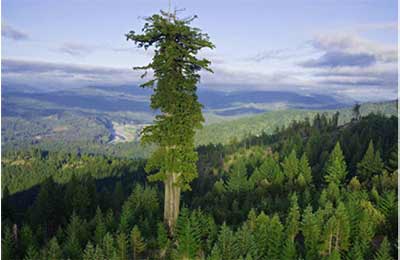
• The tallest sequoia was found in the summer of 2006 in Redwood National Park. The height of the “giant” is 115,5 metres.
• The previous record-holder among living trees was the “Stratosphere Giant” in a park in the state of California; its height is 113 m.
• A height of over 110 m is reached by 15 living trees, and higher than 105 m - by 47 trees.
• In 2004 the magazine “NATURE” wrote that the maximum theoretical height of a sequoia (or of any other tree) is limited to 122-130 m, owing to gravity and to the friction between the water and the pores of the wood through which it seeps.
• One sequoia was sawn down with a 7-metre saw over 17 days. To transport it, 30 large railway platforms were required.