

Memorial sites of Jewish history in Transcarpathia

Memorial sites of Jewish history in Transcarpathia: The synagogues of Uzhhorod
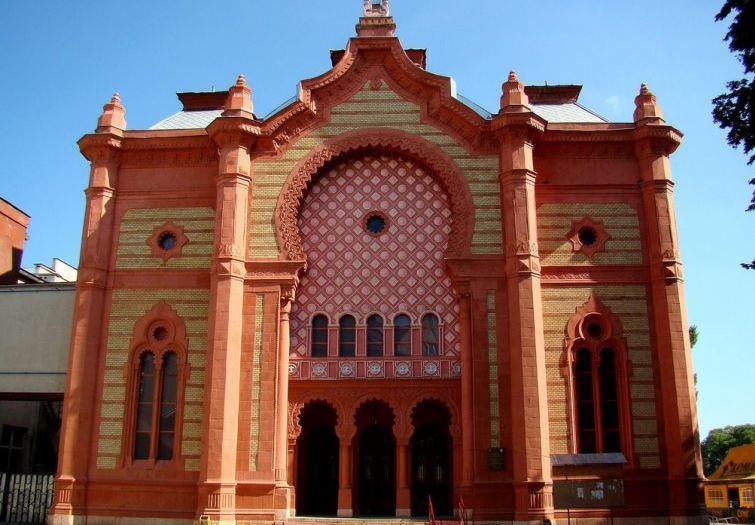
The main spiritual centre of Jewish life in the region was considered to be the unique and beautiful Hasidic synagogue (today it is the Transcarpathian Regional Philharmonic), which stands in the historic centre of Uzhhorod on Fentsyk Square. The building was erected practically more than a hundred years ago, in 1904, by the architects Gyula Papp and Ferenc Sabolcs in the Moorish architectural style, using materials brought in specially from Italy. The key element of the synagogue’s facade was considered to be the balcony at the centre of the building, where a Star of David was once depicted. In Soviet times, sadly, the star (like other elements of Jewish symbolism) was completely destroyed and bricked over, and today hardly anyone knows it ever existed. Opposite the Hasidic synagogue in Uzhhorod stands the building of the former rabbinate (today it houses a bank office). For many years this was home to Shlomo ben Yosef Ganzfried, a renowned Orthodox rabbi and the author of many books on Jewish subjects. Today his grave in Uzhhorod is a place of pilgrimage for the entire Jewish community of Transcarpathia.
Few people know it, but besides the central Hasidic synagogue, in Uzhhorod there were several more such buildings.
The Neolog synagogue on Zhupanatska Square was built in 1870 in the classical style, without decorative elements. The building has survived to this day, though it stands in a somewhat neglected condition.
The Hasidic synagogue, whose former building stands on Naberezhna Nezalezhnosti (Independence Embankment), was built in 1908. Today it houses an administrative services centre. Right next to it appears a rotunda-shaped building - this is the mikveh of 1908, where Jewish men would come to bathe every Friday.
The Falberman synagogue - this is a unique building and the only synagogue still in operation today, which has been functioning for about a hundred years. It stands on Mukachivska Street in the courtyard of Rabbi Falberman’s house.
One more, namely the former Radvanka synagogue, is located on Ukrainska Street. However, these days, sadly, it is no longer in use and has a rather unattractive appearance. In 1947 it was handed over to the ownership of a woodworking plant.
Cemeteries and other memorial sites of Jewish history in Uzhhorod
Besides its temples, only two Jewish cemeteriessurvive in Uzhhorod today. The first of them is in the Radvanka neighbourhood, where you can see matzevot from the early 19th century and a memorial stone to the Jewswho died tragically and were killed during the First World War. The other cemetery is located in the Shakhta neighbourhood. This is the largest Jewish burial site in all of Transcarpathia. It is here that many prominent and famous Jewish figures are buried. Among them, as mentioned above, is the renowned Rabbi Shlomo Ganzfried.
Other memorial sites of Jewish history in Transcarpathia are:
- the first Uzhhorod school for boys, which opened in Uzhhorod as early as 1789 and today houses the biology faculty of Uzhhorod University,
- a Jewish canteen,
- a gymnasium on Pravoslavna Embankment, built in the first half of the last century.
In the centre of Uzhhorod you can see a sculpturededicated to a real person of Jewish descent. This is the city’s well-known lamplighter, the Jewish Uncle Kolya, thanks to whom all the lamps once lit the way for local residents in the evening and at night.
Memorial sites of Jewish history in Transcarpathia: a unique heritage
The Small Synagogue in the town of Berehove - this is a unique place of worship in the most Hungarian corner of our region. The synagogue here was built at the beginning of the last century, yet it managed to pass through the entire Nazi and Soviet hell and remain «alive». Today, members of the Jewish minority still come to pray in the synagogue. And next to the synagogue you can see a unique Jewish ritual bathhouse. Overall, historians have calculated that in the not-so-distant past there were 6 synagogues in Berehove, yet «with the assistance» of the Soviet authorities only one has «survived» to this day. Today the synagogue houses a museum.
The Khust synagogue (1872-1875) was the only one in Transcarpathia to remain in operation during Soviet times. It has 9 domes, 2 prayer halls, and a balcony for women’s prayer. The Ark of the Covenant kept within it is an exact copy of the Jerusalem one. The synagogue still works today, and a Jewish Sunday school also operates alongside it, where Jews study Hebrew, the history of Israel and the culture of the Jewish people.
The synagogue building in the town of Perechyn (1903, today it houses a bank), the building of the synagogue in the town of Svaliava (today it is a BREAD-BAKING PLANT), the Mukachevo synagogue (relatively recently handed over to the Jewish community and restored), as well as synagogue buildings that today house shops, offices or post offices, can be seen in Chop, Rakhiv, Yasinia and many other settlements of Transcarpathia.