

Mukachevo’s Palanok Castle - a Treasury of European History
There are places that, once visited, stay with you in memory forever, as you long to grasp everything you have seen down to the last detail. Such places and lands are imprinted in the memory more by flashes of emotion than by the facts of dates, events and names… One of these special wellsprings of European history, which in different eras people tried to conquer, desecrate, destroy and restore, lies in Transcarpathia - in the glorious town on the Latorica. We are talking about Mukachevo Castle.
The Castle on the Hill
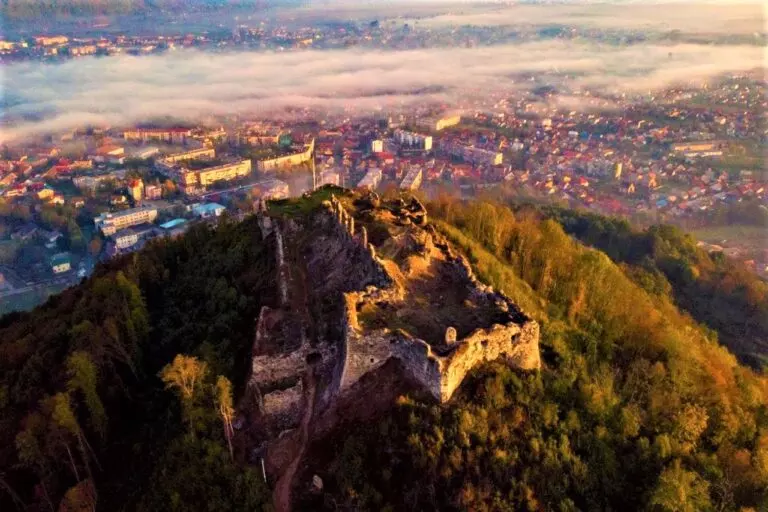
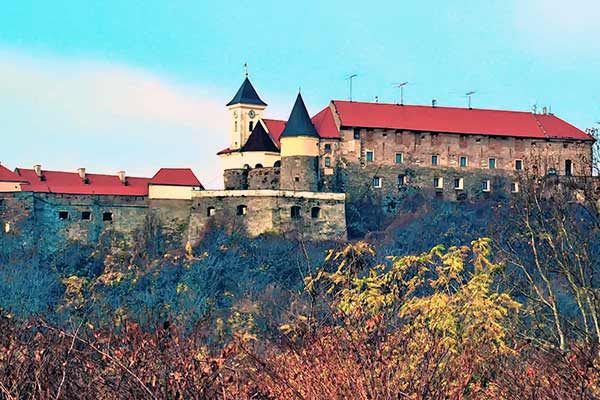 The Castle Hill, on which rises the citadel of “Munkacs”, was once a volcano. According to legend, the first hints of fortifications here appeared probably as early as the 9th-10th centuries and were made of wood. The first written mention of Mukachevo Castle was in the 11th century. And already in the 12th century the castle had stone walls.
There is another, more sinister legend connected with Mukachevo Castle: from mouth to mouth, from generation to generation, a tale is passed down that the crag on which the stronghold rises today - is not an andesite-basalt wonder of nature, but a man-made, bloody creation of the region’s inhabitants, who, on the order of their ruler, raised the hill, perishing on its slopes from hunger, cold, illness and epidemic. Hence the name of the town: Muka-chevo. From the words “muka” (torment) and “muchytysia” (to suffer).
Whether to believe the tale or not - is a matter for each person. Yet today Mukachevo Castle - is one of the five most powerful military fortification structures in Europe.
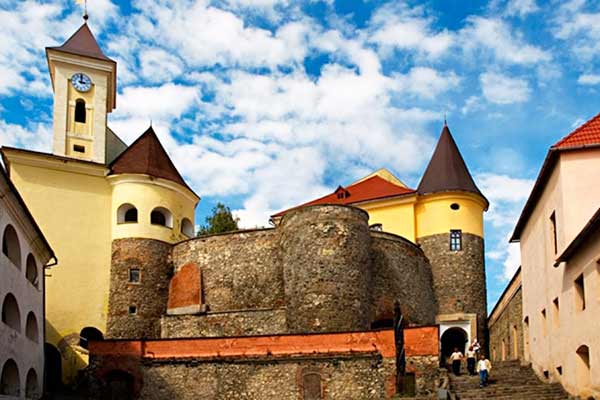
Still, there is no hiding the truth: on encountering it, the majestic building makes a twofold impression. From the outside and at a distance - it speaks in the sturdy, surviving dialect of the Middle Ages, while inside and up close - it whispers of ruin and of neologisms in architecture.
And all because, firstly, it was rebuilt by every one of its owners, and secondly, for the sake of disgrace it was once turned into a prison. Thus, tracing the authentic craftsmanship in Palanok Castle - is no easy task. Instead, the eclectic style (meaning - a blend of several architectural directions at once) is plain to see.
Why “Palanok”?
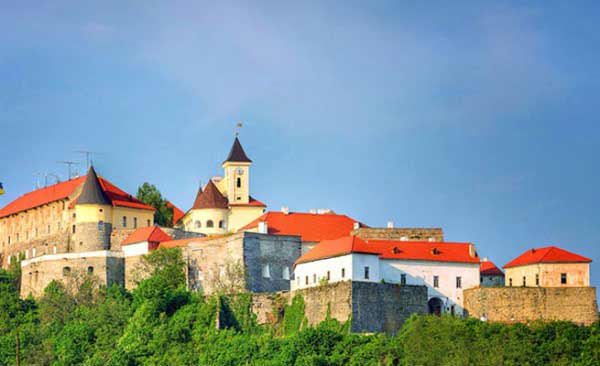 The famous enclosure - the palanok, that is a palisade of oak, was built in the middle of the 17th century. The settlement that arose beneath the impregnable stronghold came to be called by the same name. It was a sort of first line of defence, where the servants lived who carried out the household work, for example cleaning the stables. This name took deep root and passed through many centuries. Indeed, to this day the old-timers of Mukachevo call the quarters around the foot of the Castle Hill the palanok. By the same name they also call the fortress of the town on the Latorica.
Then, as now, the impregnable architectural ensemble of the castle is surrounded on three sides by a horseshoe-shaped arc of mountains. And only to the west - lies a plain, whose splendid views open up from the upper platforms of the castle.
Today Palanok Castle is one of the six Mukachevo monuments of national significance. Over the course of its history the fortification was under the crown of both the Austrian Empire and the Hungarian Kingdom. According to one legend the Hungarian crown - the symbol of Hungary - was kept in Mukachevo Castle.
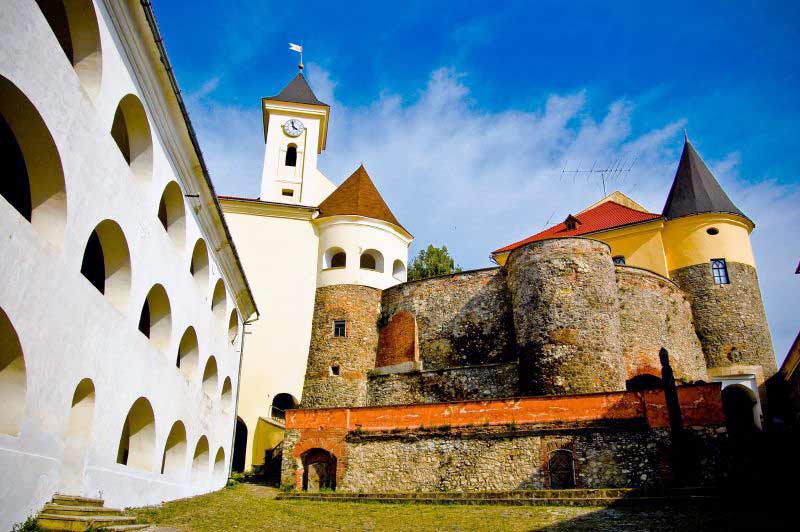 In 1570, after a lengthy restoration of the castle, a second drawbridge was erected, on the creation of which several thousand peasants tirelessly worked. The road to the castle was built at the beginning of the 18th century during the Kuruc war led by Ferenc II Rákóczi. Over the centuries of the “turbulent history of the region” the Mukachevo fortress lost five of its former eight lines of defence. To this day only three remain. Much of the authentic, original symbolism in the architecture has likewise been lost. Finding it today is very difficult, but still possible. With a good search, inscriptions, bas-reliefs and high-reliefs, coats of arms and monograms can be discovered. All of this can be seen during our Sunday excursion “Castles of Transcarpathia + Mukachevo”.
Perhaps the rarest of all is the moulding - a coat of arms from the 17th century, which tells of a remarkable woman - the creator of a sacred page in the stronghold’s history. The most famous owner of the castle was Ilona Zrínyi, who was granted a Turkish charter of valour; the peculiarity of this charter was that it was issued only to men. And Ilona Zrínyi was the first and only woman to receive one.
Planning a trip? For guests and residents of the town we have gathered all the excursions from Mukachevo on a separate page - with pick-up in the town, without a transfer to Uzhhorod.