

Salina Turda salt mine: what is inside and how to get there from Zakarpattia
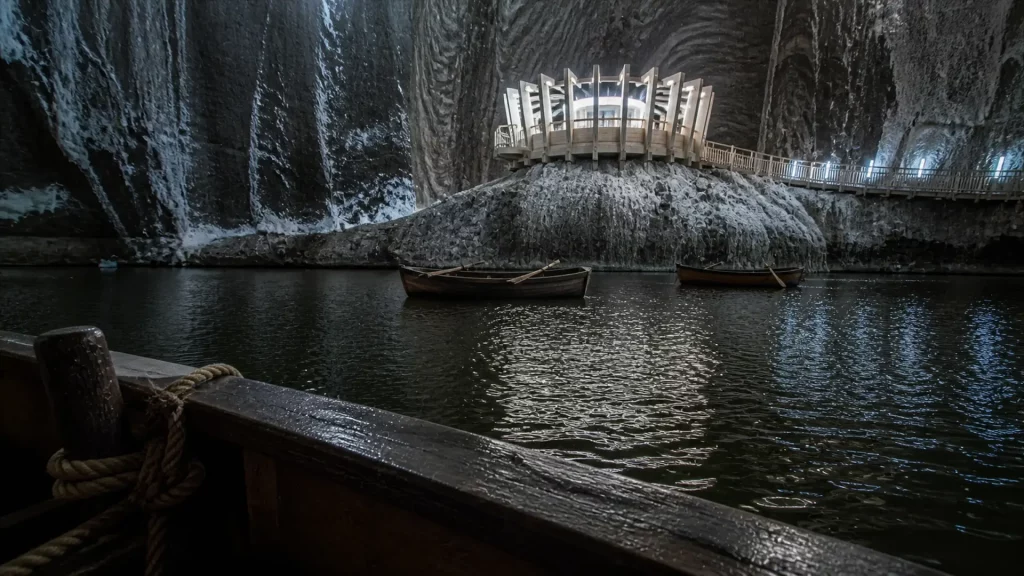
Some places are hard to picture from a description, and the Salina Turda salt mine is one of them. In photographs it looks like a set from a science fiction film, yet it is in fact a former industrial working more than five centuries old. Today, at depths of up to 80 metres, it houses an underground tourist complex: halls as tall as a nine-storey building, a lake with rowing boats, a Ferris wheel and a distinctive microclimate that people travel here for on its own.
This article covers what you actually see inside, what to wear down there, how much time to allow, and how realistic it is to reach Turda from Zakarpattia in a single day.
What Salina Turda is and where it came from
Turda is a small town in Romanian Transylvania, not far from Cluj-Napoca. Salt was mined here as far back as antiquity, and industrial extraction continued for centuries until the mine finally closed. The empty chambers were used for a while as a cheese store and as an air raid shelter, and were later opened to visitors, first as a health facility and then as a full tourist complex.
The key thing to understand before you go: this is not a museum with display cases, nor a narrow gallery you are marched through in single file. These are enormous voids inside a salt massif, fitted out with walkways, viewing platforms, lighting and leisure areas. The walls, the ceiling and the floor are all salt, and you can both see it and feel it.
What is inside: halls, lake, Ferris wheel
The complex is divided into several parts, each with its own character. The Salina Turda excursion page lists the main things the visit covers:
- the Rudolf and Terezia halls, the two largest chambers in the complex; this is where the sense of scale kicks in and people at the bottom look like small figures;
- an underground salt lake with rowing boats, located in the deepest part of the mine, inside the Terezia hall;
- a Ferris wheel, mini golf, board games and other leisure zones; yes, there really is a working Ferris wheel underground;
- a museum of salt mining history with the old equipment once used to haul salt to the surface;
- a therapeutic microclimate that is considered good for the respiratory system, which is what gave the mine its second life in the first place.
The Rudolf hall is arranged so that its tiers descend like an amphitheatre: you enter from above and gradually walk down to the floor, from where you can see the whole bowl together with the illuminated salt stalactites. It is the most photogenic spot in the complex, so allow time simply to stand and look.
Temperature below ground and what to wear
The practical detail people forget in summer: it is cool underground all year round. Expect roughly ten to twelve degrees Celsius regardless of the weather on the surface, with high humidity. The contrast hits immediately: when it is hot outside, the descent feels like walking into a fridge.
The rule is simple, then. Bring a warmer layer even in July. A light jacket, a hoodie or a windbreaker solves the problem; in a shirt alone you will be uncomfortable within half an hour, and children even sooner. Footwear should be closed and non-slip, because the walkways and steps are damp. Salt dust settles on clothing, so leave pale or delicate items at home.
One more small thing that ruins photographs: cold air fogs up a lens. If you are shooting with a camera, give it a few minutes to adjust after the descent.
How much time the visit takes
Most visitors need around two hours, and this is a case where there is no point rushing. A realistic sequence looks like this: the walk to the main halls and a first look around, the descent into the Terezia hall to the lake, time for the boats or the wheel, and the climb back up. If you are travelling with children, add a buffer, because the underground attractions are absorbing and half an hour disappears without warning.
Queues do form for the boats and the Ferris wheel, especially at weekends and in high season. That is no reason to worry, but it is a good reason not to leave them until the last fifteen minutes.
Cluj-Napoca in the second half of the day
A one-day trip to Turda is almost always combined with Cluj-Napoca: the city is close by and offers a complete contrast after the underground. The programme includes Unirii Square, St Michael’s Church, the monument to King Matthias Corvinus, the old town with its Gothic and Baroque architecture, plus free time for coffee, a walk and some shopping.
The combination works well psychologically. After two hours in the cool half-light, ordinary daylight and a city square register as an experience in their own right rather than an add-on.
Getting there from Zakarpattia
Turda lies deep in Transylvania, which makes an independent day trip from Zakarpattia a job for the very determined. The easier option is an organised departure: a coach, a group leader and a schedule that already accounts for the border crossing.
Our Salina Turda route runs for 20 hours and costs 5,200 UAH per person. Always check the current price and dates on the excursion page itself, since both are updated from time to time. Departure is from Uzhhorod, Koriatovycha Square; joining the group in Mukachevo or in other towns of Zakarpattia is possible by prior arrangement only, so tell the manager when you book. Please arrive at the meeting point 10 to 15 minutes before departure; the manager will tell you the exact time when confirming your booking.
The price includes transport by comfortable coach, the services of a guide and the excursion programme itself. Entrance tickets, meals and personal expenses are paid separately. Children under 14 travel accompanied by adults only, children under 12 have a separate price, and groups of 7 or more receive a 10 % discount.
For travel abroad you need a biometric international passport; we recommend checking the current border crossing requirements before your trip, as the rules change periodically.
Who this trip suits
Salina Turda is a strong choice for anyone who has already seen the standard European cities and wants an experience of a different kind. It also works well with children: an underground Ferris wheel and boats on a salt lake need no further explanation.
The one thing to judge soberly is the format. Twenty hours is a long day rather than a gentle outing, and it is wise not to plan anything critical for the following morning. If you want Romania in a shorter format, look at the other routes on the excursions to Romania page, which include Maramures with the Merry Cemetery and a trip combining Sighet with the salt lakes of Solotvyno (a Ukrainian village in Zakarpattia, incidentally, not a Romanian one). And if you are still choosing a destination at all, it is easier to start with the full list of one-day excursions to Europe, where all five countries appear with their durations and prices in one place.