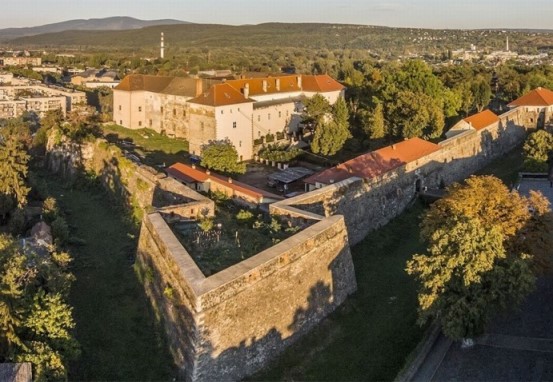
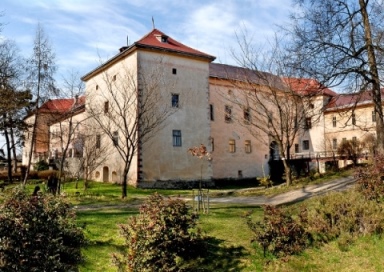
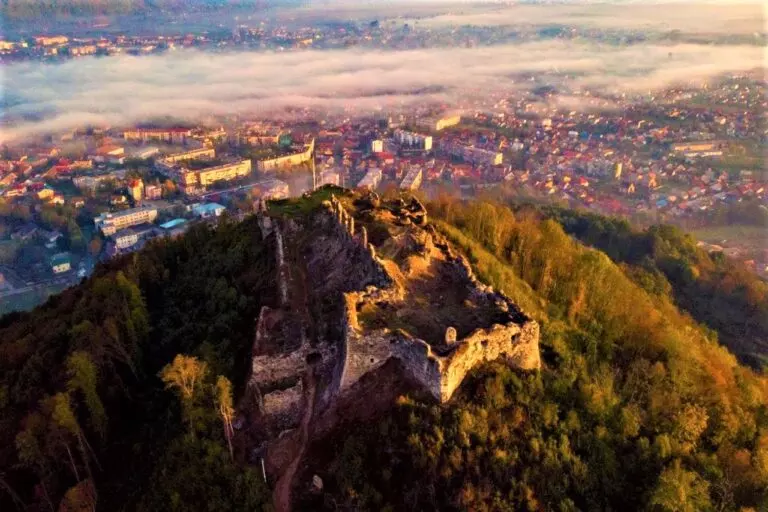
The majestic Uzhhorod Castle rises proudly above the city. The fortress, which has literally grown out of Castle Hill, is one of the most valuable military and architectural landmarks of the region. It is a unique bastion-type fortification and a true masterpiece of the Romanesque architectural style in Uzhhorod. The stern appearance of the castle, its mighty, grey walls, in their silence tell better than any tale of the storms that have swept over it. For a moment it seems that time has stopped here.
Uzhhorod Castle: an astonishing thousand-year history
Behind Uzhhorod Castle trails a thousand-year plume of history. It is known that already in the 8th century there was a hillfort of the Slavic tribe of the White Croats on the local hill. Later, in the late 9th and early 10th centuries, a wooden fortification (a palisade and inner ward) was built on this spot - it was here that the residence of Prince Laborets stood. But very soon the fortress was burnt down by the Hungarians, who attacked the prince’s domains. After a time, the Hungarians conquered the territory of the citadel and rebuilt the castle. And in the 14th century, the Hungarian king granted the fortress to the renowned Italian Drugeth dynasty, who ruled here for almost four centuries.
Uzhhorod Castle was rebuilt many times over the centuries - the development of fortification structures demanded it. The castle underwent its most significant innovation precisely in the time of the Drugeths, at the end of the 16th century, when Italian masters laid out the plan of the castle’s fortifications, which has survived to our day. The rebuilding of the castle is attested by dates carved in several places above the entrance gates.
The castle’s military-defensive system is simple and yet mighty. On three sides the fortress is surrounded by a moat cut straight into the rock, and on the fourth - by a steep precipice. The Uzhhorod citadel is an irregular quadrangle with bastions at its corners, enclosed by a fortress wall. The massive square bastions project slightly forward - this made it possible to fire along the fortress walls. Artillery was positioned on the bastions, keeping the approaches to the castle under fire. The castle walls and the corners of the bastions are laid with stone. And only here and there can you spot breaches bricked up - these are the traces of a long siege.
The castle in Uzhhorod was besieged countless times, especially in the 17th century - during the years of religious struggle and mass peasant uprisings. The last time the fortress came under siege was during the Habsburg war of national liberation. It was then led by the famous Ferenc Rákóczi II, another “master” of the castle. Later the fortress was ruled by Miklós Bercsényi - it was he who made Uzhhorod Castle the main centre of cultural and political life. And in the second quarter of the 1700s, Uzhhorod Castle was even handed over to the Uniate eparchy, which housed a theological lyceum here right up until the arrival of the Soviet troops.
Details of the layout of Uzhhorod Castle
In the porch of the fortress’s main gate stands a fireplace, where the changing guard once warmed themselves. Look up at the ceiling - there you can see the traces of an opening through which boiling water or hot tar was poured from the gate tower onto any enemy who had slipped inside! Opposite the gate stands the main defensive block - the palace, and it is this that holds the dominant position in the castle’s defensive system. This massive quadrangular building with mighty square towers has a small inner courtyard. The block itself, like the castle, was surrounded on all four sides by a moat, across which a drawbridge was thrown - nowadays replaced by a wooden one. In the inner courtyard you will see a well cut 30 metres deep into the rock. Not far from the palace stood the castle church of St George - today only its foundations survive. Locals tell that it was here that Transcarpathian bosorkanky - witches - were once burnt.
The palace of Uzhhorod Castle has two floors (before the fire of 1728 there were three) and 40 rooms. On the second floor is the largest hall - the knights’ hall. Beneath the palace lie spacious dungeons - casemates, which served as storerooms and a refuge for the castle’s inhabitants during a siege. Today they host unrivalled tastings of fragrant Transcarpathian wine . A prison and a dreadful torture chamber were also located here, whose exhibits you can view even today.
Art and culture in the castle
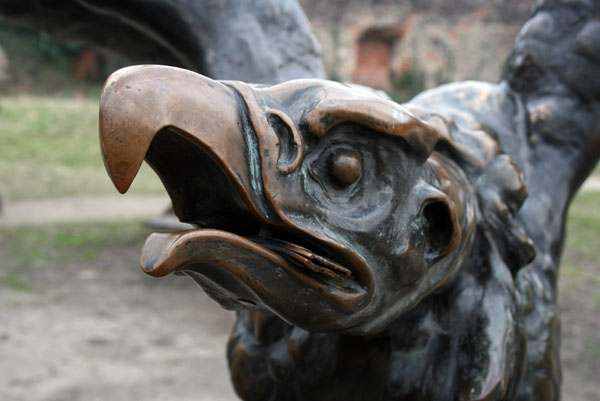
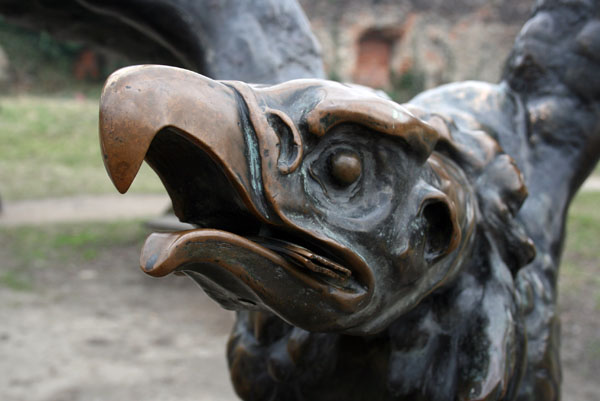
In the castle courtyard stands a cast-iron statue of Hercules slaying the Lernaean Hydra - this monument of the foundry art of 1842, once so highly developed in Transcarpathia. Not far from Hercules, another well-known figure of Greek mythology awaits you - a sculpture of Hermes. A few steps more - and you will see a bronze statue of the Turul - the mythical bird of the ancient Magyars. And from the eastern bastion a breathtaking panorama of the picturesque Uzh valley will open up before you.
Today the premises of Uzhhorod Castle house a local history museum with unique exhibits and rarities. Right nearby, on the southern slope of Castle Hill, lies the skansen - the Transcarpathian Museum of Folk Architecture and Life under the open sky. Not far off you will see a true masterpiece of the city’s sacred architecture, its main spiritual centre - the Holy Cross Cathedral .
The legend of Uzhhorod Castle
According to one legend, a ghost still lives in Uzhhorod Castle - the White Maiden. There is a version that she was the daughter of Count Drugeth himself, the owner of the fortress, who disobeyed her father and fell in love with a voivode from the enemy camp of the Poles, who sought to conquer the fortress. Blinded by love, the girl revealed to her beloved all the secrets of the citadel’s underground passages. For this the hapless girl was walled up alive in the castle wall. Ever since, at midnight, dressed in a white gown, she emerges from her hiding place in search of her beloved and weeps piteously.
You can stroll through the ancient Uzhhorod Castle and learn all its secrets on our sightseeing excursion around Uzhhorod.