

Kankiv Castle - a legendary fortress on a volcano

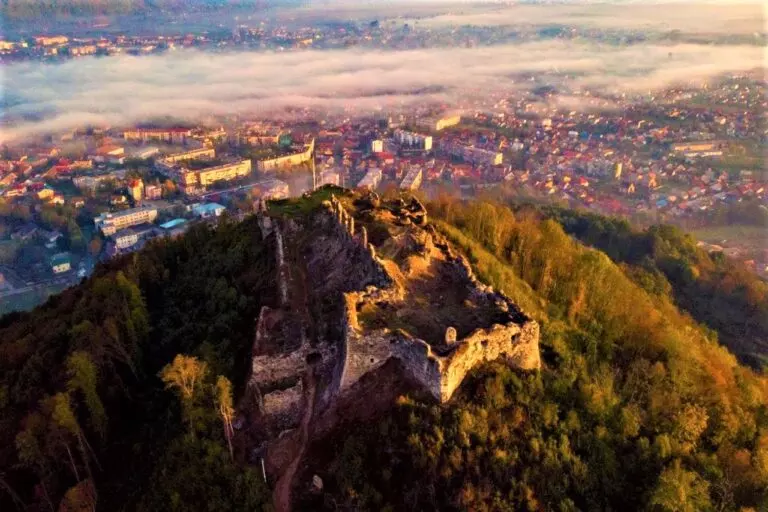
Chorna Hora - is a real dormant volcano and the warmest western point of Ukraine, upon which stands the Ugocsa, Sevlyush Castle, or the fortress of Kanko - as the famous Kankiv was called in various historical eras. As for where such a name came from - there are many versions. One of the most popular says: «Kanko» from Hungarian translates as «stones, a stone boulder». It is also believed that the castle was once owned by the brigand Kanko, who robbed people. According to other claims, the fortress was named by the monks of the Franciscan order who lived here - they wore huni (outer garments of coarse sheep’s wool), calling them «Kanko», and for their sewing they used a special fabric - Kanko. The castle was dubbed Ugocsa or Sevlyush because ancient Vynohradiv was once called Ugocsa, and later - Sevlyush.
Kankiv Castle in Vynohradiv: a royal past and feudal feuds
It is not known exactly who built, and when, Kankiv Castle. It is first mentioned in Hungarian chronicles of the 10th century, where it is stated that this clay stronghold was raised by Slavic tribes. Later the fortress became a possession of the Hungarian Kingdom. In the late 1200s Sevlyush, also known as - Vynohradiv, received royal privileges and Magdeburg rights. Kankiv Castle was completely rebuilt and became the most important outpost, for it was here that the famous Salt Road ran: salt from Solotvyno was carried straight to Europe. It was during this period that the fortress belonged to the renowned Hungarian magnate Beke Borsa, during 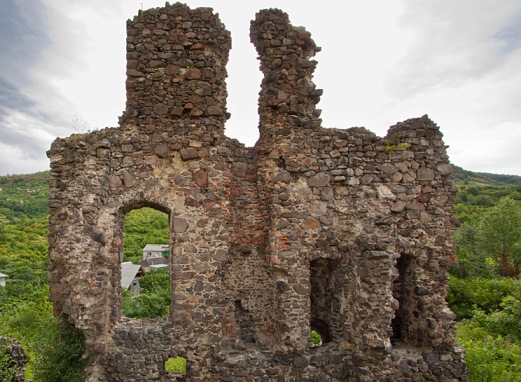
The castle’s new owner and its legend
Later the new Hungarian king Sigismund, as a reward and token of gratitude, gifted Kankiv Castle to the famous baron Peter Perenyi, who fought heroically against the Turks in the late 1300s. The fortress was somewhat rebuilt and renovated, making it entirely of stone. However, Perenyi already had a castle in the neighbouring village of Korolevo, so he decided to give Kankiv to the Franciscan order, who fortified the fortress and set up a monastery here for almost two centuries. According to legend, the Franciscans kept here the relics of Janos Capistran (by one version he was the Italian Giovanni Capistrano), one of the most famous and revered Catholic saints, who won fame in the Hungarian-Turkish battle in the mid-15th century. The castle well was named precisely in his honour. There is a legend according to which the monk Capistran was buried in a coffin on two golden chains in the castle cellar. In addition, there is an underground tunnel shrouded in mysteries which, as the stories go, led to the Roman Catholic church in the centre of Vynohradiv. Whether this is true or not - is unknown, but in Soviet times archaeologists did indeed excavate more than 10 metres of this tunnel.
From flourishing to ruins: what remains of Kankiv Castle today
Soon afterwards the Franciscan monks were killed and expelled, and Kankiv Castle itself was completely destroyed - and, oddly enough, this happened because of the fierce zeal of a descendant of the Perenyi family - Ferenc, who, having married the daughter of a Protestant 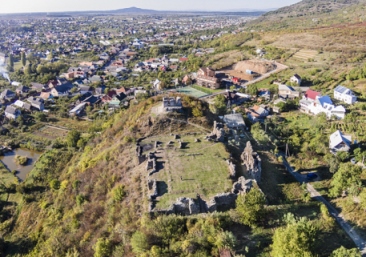
Thereafter Kankiv Castle was never restored again. The snows and rains «finished off» the building, local residents took it apart for stone, and vineyards were planted around the place where it stands.
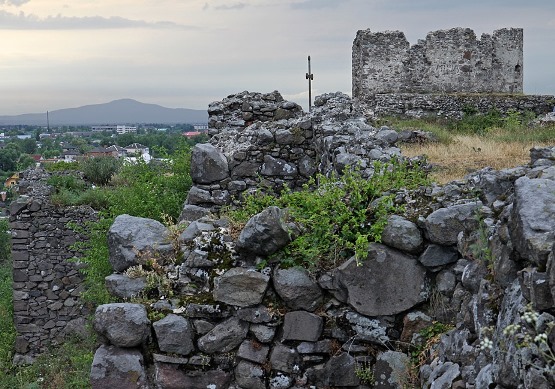
Today Kankiv Castle - is one of the calling cards of Vynohradiv . Only its ruins have survived to our day, having witnessed truly heroic events. These are the outlines of the defensive perimeter, the stone walls of the building, fragments of fortifications. During archaeological excavations, the foundation of a Gothic church was found - a copy of the Franciscans’ church in Vynohradiv. Best preserved today is the monastery chapel with a cross, built by the Franciscan monks. The cinema industry has also somewhat embellished the castle , for several films were shot here, the most famous of which is the cult «The Camp Goes to Heaven». There are plans to study the fortress further - historians and archaeologists are convinced: genuine sensational discoveries are preserved here.
You can visit the legendary Kankiv Castle during the excursion to royal Vynohradiv.